The offshore conundrum

The uproar over the Royal Bank of Canada’s outsourcing IT jobs last week brings to mind the tremendous problem that appears in the industry. The bank, as well as the many other companies that outsource IT jobs to countries which historically lower average wages, claims that the practice allows them to be more competitive.

This has raised the complaint that Canadian IT workers, who earned an average of just over $68,000 annually (Statistics Canada, 2011 figures), should be more competitive. And, here is where the problem lies.

Look at the requirements for your standard worker in the Information and Communications Technologies industry sector. I have a favourite first assignment in two of my courses, where students check the job market to determine what employers are looking for. Some trends are quite evident.

Employers are looking for workers with a minimum of a two-year IT diploma, or a bachelor’s degree in Computing and Information Systems. Frequently, positions require additional industry certifications pertinent to their specific job requirements. Most jobs above the introductory level have minimum experience requirements as well, and the last time my classes went through this exercise in January, these jobs were calling for a three to five- year period of experience for a mid-level job.

Consider these requirements. These workers have invested a minimum of two years in school getting an IT diploma or four for a bachelor’s degree. On top of the costs and time, industry certifications involve experience and the examinations are often costly. For example, the Microsoft Certified System Engineer exams, of which there are 7, cost about $185 Cdn each. Further, these are usually applied exams, where the people taking them are expected to be able to answer questions based upon real life situations rather than simply regurgitate information and people are recommended not to attempt the exams until after at least a year of experience with the product.

On top of this, the average IT program prerequisites call for higher math and problem-solving skills and strong communications skills. The field calls for an above average student to meet the heavy requirements of a position with a high level of technological knowledge and the ability to meet the very flexible requirements of the position. In short, this is usually a field for the “best and the brightest,” who have very good academic skills and has invested a great deal of time and money to obtain a mid- to higher level position.

So, here’s the conundrum. We expect substantial requirements for workers in the field, yet are unwilling to pay them an appropriate salary. We have certainly seen the effects, with all of the major banks in Canada outsourcing many of their IT positions in recent years. Given this trend, we can only assume the trend will continue, with the loss of both jobs and capital from the country…


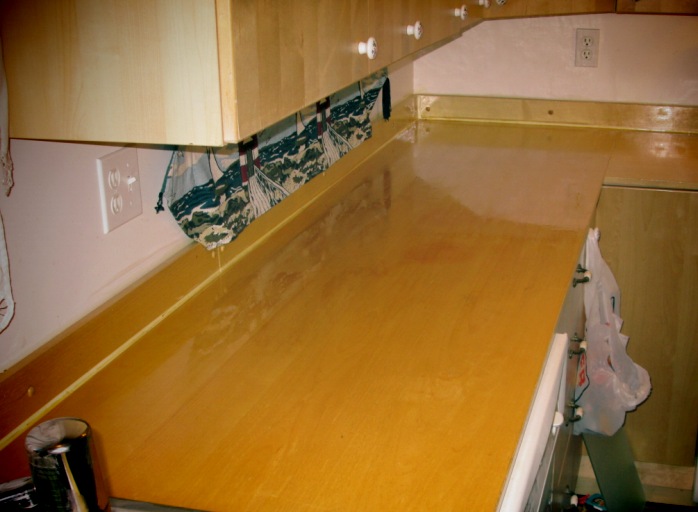
The counter top refinished

Clara is out of town, which leaves me in the house without adult supervision. This immediately prompts me to conduct myself in such a fashion as I cannot when she is around.

Now, before you start planning the wild parties, I should mention that much of this centres on Clara being allergic to “fumy” substances and fish. Of particular note is polyurethane, since it can level people who aren’t that sensitive, too.

Our countertops in the kitchen were a stop gap measure to allow for the plumbers to finish. I ordered the cabinets from Ikea, and were quite content with them. However, when I went to order the counter top, they were backlogged and it would require about 2 to 3 weeks before they could be finished. At the same time, Gary, my plumber, wanted me to get this finished so he could install the kitchen sink and finish up the plumbing for the new house.

Two of the things that came with the cabinets were several large cover plates. These are the finish pieces that cover the white cabinet carcasses and match the doors. However, the cabinets, like the doors, were also pine finished and I didn’t need them. Sending them back would have cost more than it was worth and I was wondering what to do with them. Now, I had a plan.

I ran them through the table saw to cut them to size, and cut off backers. Then, I used them as counter tops that actually matched the cabinets. This would hold me until the real counter tops could be delivered and installed and I would just have to reinstall the sink afterwards. However, when we put them in, they looked so nice that we held off on ordering the proper counter tops. That was in the spring of 2005, and they have been in place since then.

counter image
The refinished counter top.

The one downfall of this is, despite looking nice, they are made out of laminated particle board and dent and mark easily. However, a couple of coats of polyurethane every two years keeps them reasonably well protected.

They are showing their age, and I don’t think I’ll refinish them again. Instead, I’m kind of thinking a nice oak plywood counter top in a few years, with a slightly darker stain for contrast. But, that should be about two more years down the line, given the length of time refinishing them lasts.

Of course, with Clara gone, the first meal prepared on them involved scallops…

St. Patrick’s Day

You would think that being of Irish descent, although Northern Irish Protestant descent, you’d get St. Patrick’s Day as a bit of a holiday.

However, being a musician who plays mostly Celtic music, the possibility of a holiday is a bit out of reach. I’m popping over to the Airport Chalet Hotel tomorrow night, the United Church Sunday afternoon, and playing in the lobby to open for Maeve Mackinnon at the Yukon Arts Centre Sunday night.

Holiday? That ain’t happening…

The Tōhoku earthquake: Two years later

Today, March 11th, marks the second anniversary of the Tōhoku megathrust earthquake and tsunami that struck the east coast of northern Japan, killing an estimated 20,000 people and destroying or damaging over 1,000,000 buildings. The earthquake, with a magnitude of 9.03 M, took place on the seabed 70 km offshore, generating a tsunami that reached a height of 15 m in some locations. This was the largest recorded earthquake to hit Japan, and the fifth largest instrumentally recorded earthquake in history. The quake actually moved the earth’s axis about 7 cm, resulting in shortening the length of a day by 1.8 microseconds. The World Bank estimates the costs of damages at US $235 billion, the most costly natural disaster in human history.

Two years later, many residents of the affected areas have experienced great difficulty beyond the immediate tragedy. Many are still in temporary housing and the rate of recovery operations have been complicated by issues such as failure to allow people to rebuild in some of the affected areas and the clearing of others. Many people are experiencing the difficulty of needing to rebuild their homes, while still being stuck with the burden of needing to pay the mortgages on the destroyed ones. It is difficult to even consider when the lives of many will ever revert to some semblance of “normal.” For many, it never will. Of particular issue is the meltdown of the Fukushima Daiichi power plant complex and its future ramifications for resettling the immediate area.

People have, by nature, an inability to accept the scope of such a disaster. It is difficult to conceive of such consequences from a single act of nature. Perhaps we should consider the human cost in one way that may let us appreciate its effects.

The median age of the population of Japan is 44.6 years. While this is strictly a rounding figure and may not be totally accurate for our considerations, it could be considered that each of the victims may have ab0ut 44 years of friends, family, loves, fears, and all of the other things that make up a lifetime. In this view,  the death of 20,000 people reflects a loss of 892,000 years of cumulative human experience, and maybe this is a perspective that makes such a disaster more easy to comprehend, and mourn…

Remiss

I’ve been remiss. As you can see, it has been a bit since I put up my last blog post.

I have been busy, with work, writing a play, coming to some arrangements on my What’s Up Yukon column (now regularly scheduled for every two weeks), emceeing an interactive murder mystery, and now, prepping playing for St. Patrick’s Day.

That being said, I’ve decided to be somewhat more dedicated. Honest. I promise…

Christmas Eve

Another Christmas Eve is here and, since I know many who do not celebrate Christmas, I will simply pass on my standard sentiment. But to preface that, on December 24, 1968, Wlliam Anders took what is probably my favourite, and in my view, the most important Christmas picture.

earthrise, Dec. 24, 1968

Peace on earth, goodwill towards all.

Remembrance Day

On this Remembrance Day, like others, I am constantly amazed at how lucky we were that all of our immediate relatives who served in recent memory came home.

Dad's medals

Dad’s medals, Korean Service medal second from right.

My mother’s three older brothers served in bomber crews through much of World War II. Dad served on a destroyer in Korea.

For some frame of reference, the average life span of a bomber crew member during most of the war was three missions. While the navy was certainly safer in Korea, we did take losses on the HMCS Iroquois in 1952 and this is always a possibility in war.

All but Uncle Bob are gone now, but on this day, we remember all of those didn’t return, or returned broken. They went willingly. And all of them, whether for the Boer War, Spain, World Wars I and II, Korea, a myriad of peacekeeping missions, Bosnia, Kosovo, Kuwait, Afghanistan or Libya, went knowing that they may not return. That, in itself, is worth remembering, and probably for more than one day a year…


Ever have one of “those” days?

Every so often, the Fates look at a randomly-generated list of names, run their finger down the list and say, “Hmm. Let’s just get… ah, that guy.” Today, it was my day.

My work day started with me forgetting to bring my office keys. This creates a few issues throughout the day and means I need to constantly borrow a key from someone else. In short, it’s a real inconvenience.

Then, after a while, I headed out to my physiotherapy appointment. I arrived on time, or so I thought. The time I put in my appointment calendar was 9:40 but, apparently, my appointment was for 9:20 and I missed it. By the way, my physiotherapist has no open times this week and is off next week.

I get back to the office to set up for this afternoon’s class. I have a class on routing and remote access servers. Guess what? My server has crashed some time this morning. The means I end up spending an afternoon trying to explain a practical-oriented class on an abstract concept with no way to actually demonstrate how you configure things.

On top of that, the online class software we use doesn’t like working with dual monitors. Trying to put notes on the whiteboard was interesting since, every character I typed, the window jumped from monitor to monitor. Try to concentrate while watching your workspace jump from one monitor to the other every time you type a letter.

With all the kerfuffle, I didn’t get a chance to have lunch. That’s OK, since I have an ice pack in it so it will last long enough to take home at the end of the day, put it in the fridge, and bring it tomorrow. As I sit at home writing this, guess what is still sitting back in my office.

So, in short, everything I touched today either broke or failed to work properly. You can understand why I’m afraid to pee…

For sale: one vote

We have an election coming up, namely, the municipal election for the city of Whitehorse. Voting day is October 18th. Elected will be a mayor and six councilors. There is no incumbent running for the mayor’s position and four incumbents running for council seats.

This means I have less than two weeks to figure out who gets my vote (actually, multiple votes as you check off one vote for mayor and up to six for council. There are 5 mayoralty candidates and 22 running for council). In the 21 years I’ve lived here, I’ve voted for a possible mayor every time but have yet to actually cast six  council votes in any election.

Checking out the list of candidates this time around, I don’t see much hopes of finding six to vote for again. It was only shortly before the deadline for nominations that I could see a choice for mayor that didn’t include “none of the above.”

So here are some hints for those who want to get voted in. Note that this probably applies for all elections. A political campaign is a job interview of sorts and the electorate’s only way to choose the right person for the job is the platform put forward by the candidate. So, when expressing your platform:

1. If you intend to deal with an issue, explain how you intend to fix it in detail. Everyone loves kittens, rainbows and unicorns, but general campaign promises without details are usually best moved to the field with a backhoe to make next year’s crop grow that much better. If you cannot provide details, it means you know nothing about the subject other than what to call it.  Honestly, we have enough elected representatives who know nothing. We don’t need more.

2. Prove you have an understanding of jurisdictional responsibility. Each level of government has its responsibilities. If you’re running for one, don’t make promises about things that come under another level of government. This only indicates that you have no clue about the position you aspire to, and probably indicates your level of qualification for it.

3. If you promise something, be prepared to vote that way when the time comes. There is no excuse for supporting something you said you would not support or vice versa. The common story is “after studying the issue,…” or words to that effect. If it was a promise made in your campaign, it meant that you already studied the issue, or should have. Changing your mind in this manner means you either knew nothing about your stand on the issue, or you simply meant to lie your way into office. Unfortunately, we have too many of those cases, too.

4. Have some idea of how financing works. While governments and businesses run through two completely different models and experience in one has no relevance to the other, the general rules of finance are still the same. You can only spend what comes in. Whether through transfers, taxation or borrowing, this income is the maximum you have to provide vital services. And, unlike a business, you simply can’t close the plant and move to somewhere offering lower operating costs. Explain (in detail, again), how you intend to meet your promises and still afford to provide those services.

5. Be honest. Admit it when you don’t know something. Take responsibility for those times when your ideas don’t work. Sometimes you’re going to have to make unpopular decisions (some of the decisions the current council have been decried for are some I heartily approved of). People aren’t going to be happy with everything you do, but will be far more willing to accept it, grudgingly, if you can show you honestly and sincerely feel this is the best choice. The only way to do this is have a long history of being honest and sincere and it doesn’t take much to indicate that these are characteristics you don’t have.

So, there’s my pitch. These aren’t that much in the way of demands for buying my vote. I know it seems a lot, but you’ll probably find that the same price will purchase far more votes than mine…

An odd start to a morning

This morning started in quite an odd, but interesting, manner. The oddity began when I went out the front door to drive to work. On the fence between the front and the back yards, there were several magpies. They were looking over the fence and squawking like they were upset over something. So, I figured I’d walk over and look.

This was the odd part. Magpies are members of the jay family, which includes crows and ravens. And, if you’ve ever had any experience with magpies, you’ll know they are incredibly wary of people. Try to walk up to a magpie and see how quickly they disappear. This time, though, they didn’t. I was about two feet from the nearest one sitting on the fence.

Near the base of the fence, lying on the ground, was a dead magpie. The other magpies seemed far more interested in the dead one than me. They perched on the fence and squawked. Bagging up the dead magpie and putting it in the garbage container at that point didn’t seem appropriate, so for some reason I muttered, “Excuse me,”  walked back to the truck and drove to work.

When I came home, I dealt with the dead magpie. There was not a mark on the magpie so it wasn’t a predator of some sort that killed it. I don’t know what happened to it. It didn’t seem old.

The odd part is that, this morning, I felt like I had attended a funeral. Since they didn’t fly off like they normally would, I felt like I was invited. I don’t know if this is common behaviour with magpies, but if funeral ceremonies are good enough for people, they should be good enough for them, too…