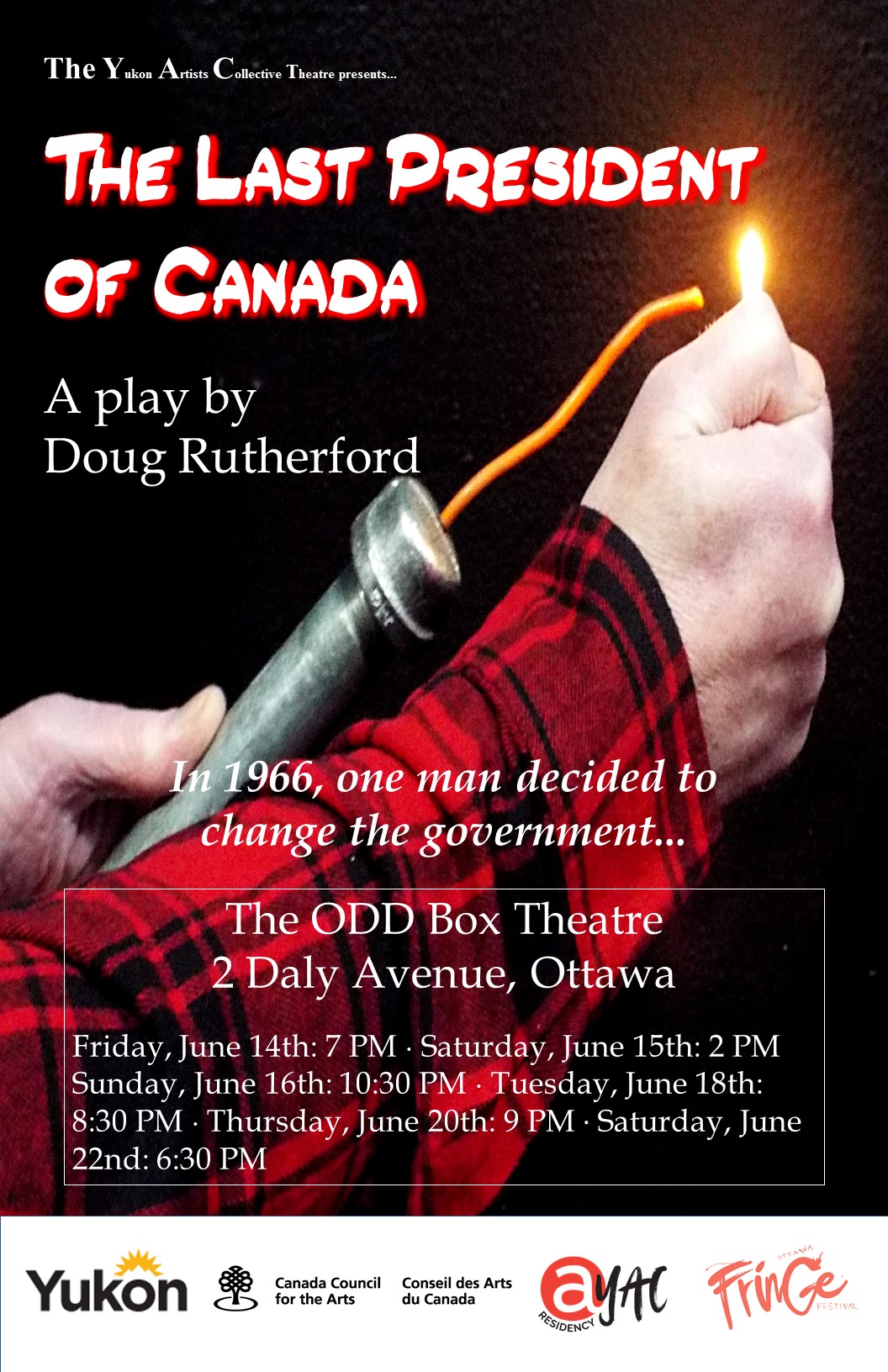
Well, the schedule for the Fringe has be finalized and here’s the poster.

Watercolour Landscapes of the Yukon
Well, the schedule for the Fringe has be finalized and here’s the poster.
Well, this year’s 24-hour playwriting competition has come and gone. I didn’t win any prizes this time, but I still have a lot of fun every year doing this.
This year was a lot of fun, since I did something on a character that I’ve always wanted to do, Paul Chartier. He’s an important figure from Canadian history, although most people will answer, “Who?” if you mention his name. I figured it was time to do a one-man, multimedia-assisted approach to his story.
As part of the festival, I did a short reading the other night, so here’s the excerpt I read. Note, of course, that this is a draft and still needs a bit of work.
CHARTIER
Nakai 24 Hour Playwriting Challenge Cabaret
2017
SETTING
In 1966, Paul Chartier wrote the Speaker of the House of Commons asking to address Parliament. He was refused and died shortly afterwards. Now, he has been given his chance to address Parliament more than 50 years after his death, from the afterlife. The section being read takes place when he first appears before the House. The stage itself is empty, other than a projection screen with a slide of the floor of the House of Commons showing. He turns to the audience and begins his address.
PAUL
Hello. My name is Paul Joseph Chartier. I was born in Fort Kent, Alberta, near Edmonton.
I don’t know where I am now, or how I know things that have happened since… since I died in 1966.
I wanted to speak to you on that day. I wrote a letter to the Speaker. The clerk wrote back and said that only members of parliament could speak here. I am glad to have this opportunity to do this after all this time.
Please. I’m very nervous. I wasn’t given any time to get ready.
(Paul stares at his speech in his hand for several seconds.)
I have this speech. I was going to give it that day. But, I think I should explain what happened.
I was angry. After all the things you have done to me, I had no way to tell you. You wouldn’t have listened anyway.
So I went to a hardware store in Newmarket. I bought ten sticks of dynamite. I opened six and put the explosive in a copper pipe. I had about two pounds of explosive in it.
I’d also bought detonators and some fuse. And then, I went to the parliament building. I had three fuses on my bomb. I had a short one, a medium one, and a longer one. I didn’t know how long to make the fuse, since I had to find out how long it would take to get from the bathroom back to the gallery so I’d know how long it should burn. I didn’t want it to burn for too long, or when I threw it on the floor, someone might realize what it was and put the fuse out.
I couldn’t sit in the visitors’ gallery that day. It was full. There was 900 school students there. I thought I would have to wait for another day to do it.
But the Commissionaire let me sit in the Lady’s gallery. They do that when it’s crowded. I was right above the centre of the floor. Right above Lester Pearson and John Diefenbaker. And, they were the two main people I wanted to kill, although I really wanted to exterminate as many of you as possible.
So, I went out to the bathroom. I counted how much time I would need to get back to the gallery. Then, I went into a stall and lit the middle fuse. And, before I could even open the stall door, it went off. I died.
People laughed at me! And, it wasn’t my fault. It was that bitch at the hardware store.
I’m sorry…
I figured I needed about 20 seconds of burn time for the fuse. Twenty seconds. And I thought I had calculated it correctly. She told me it burned at 1 minute a foot. Twelve inches! One minute! I needed about 3 or 4 inches of fuse. So that was the one I used.
But, she sold me the wrong fuse. It wasn’t 60 seconds a foot. It was 40 seconds a foot. It burned for less than 10 seconds. I lit it, put it under my coat to hide it when I brought it into the gallery. I’d walk down to the railing, throw it down, and I’d give you a blast to wake you up.
But, I never even got out of the bathroom stall.
This is my legacy now. I wanted to change the country, to make it better. I wanted parliament to care about the people who make this country run.
And, all I succeeded in doing was to blow up the third floor men’s room in Centre Block of the Parliament Building. And myself. I died in a fucking toilet stall.
And it’s not fair. It should have worked.
I should start this with a bit of a disclaimer. Being of Northern Irish descent, I have a great dislike of bombings. Go figure.
With the two suspects, and no one has been convicted yet so “suspects” is the appropriate word, dealt with in one way or another, we now wait to get the important questions answered. The first of these is, “Why?”
Terrorism is a political tool. It serves to compel people to alter their way of life enough that governments will give in to the political aim or aims of the terrorists.
While religious extremism is often given as a “cause” of terrorist activity, there are not many examples of terrorism being based on strictly religious grounds. Northern Ireland, for example, is often shown as an example of Catholic vs. Protestant terrorism, yet the main aim of terrorist acts on either side was to aid or prevent the separation of Northern Ireland from Britain. To this you can add the fact that there were Catholic Loyalists and Protestant Republicans. The actions of the Palestine Liberation Organization were presented as “Islamic terrorism,” yet the aim of the PLO was the destabilization and destruction of the state of Israel, a political rather than religious aim.
What is not immediately obvious in this case is what they hoped to accomplish. While the suspects were originally Chechans, both of whom lived for some time in their early lives in Dagostan, it seems that the US makes an odd target. Russia would have been a more logical target, if Checan separatism was their cause. Hopefully, the remaining suspect can provide some insight on the reason for the attack. Note that there is no guarantee that the reason he provides will be the actual one, although I suspect that anyone willing enough to make such a public statement as bombing the Boston Marathon will be equally willing to have the chance to air his grievances in a public forum.
Perhaps the second most important question is, “Why terrorism at all?” Terrorism almost never achieves its end. There are very few examples of terror resulting as the sole cause of its stated aims.
Only two from the last century come to mind, and terrorism itself was not the main cause of the success of the movements in question. The eventual withdrawal of Britain from Palestine and the formation of the state of Israel was aided by terrorist bombings, but the weakness of the British armed forces after World War II and the guilt of failure to act to end the Holocaust were probably far greater factors.
The separation of the Irish Republic from the UK was a foregone conclusion. The first attempt by Britain to divest itself of a troubling colony was the first Home Rule Act in 1886 (which fell in the Commons), followed by the Second Home Rule Act of 1893 (passed the Commons but defeated in the House of Lords), and the Third in 1914, which passed and received Royal Assent, but was not implemented due to the beginning of World War I. Efforts to give Ireland Home Rule predate the formation of the Irish Volunteers in 1913, who later became the Irish Republican Army in 1917, so they were not the only factor in the formation of the Republic of Ireland.
Will we learn anything from this? That remains to be seen, and, hopefully, what we do learn will eventually reduce the chances of it happening again. I don’t hold much hope, since it is obvious is that the negligible chances of success for terrorism seems to have no deterrent for those willing to employ it…
“And those who give the orders they are not the ones who die…” – Tommy Sands
 Doug Rutherford