To whom does your MP answer… if he does at all

It has been nine days since I e-mailed Ryan Leef, MP for the Yukon, regarding direct government intervention in collective bargaining for Crown corporations. To this point, I have not even received a response, despite specifically asking for one.

I have heard others complain that they have contacted him and not received so much as an acknowledgement from his staff that they even received the request. Therefore, if you work for Mr. Leef and have the opportunity to read this blog, please remind him that, within a Westminister government, he works for his constituents. Unfortunately, I have seen little to indicate that he is aware of this.

An open letter to Yukon MP, Ryan Leef

Here’s an e-mail I sent to Ryan Leef regarding the clauses of the budget bill relating to oversight of crown corporations. If you live in Yukon and feel the same way, please ensure you contact him and point out the promise he made in the election. His e-mail is ryan.leef@parl.gc.ca.


__________________________________________________________

Hon. Ryan Leef, MP
House of Commons

By E-Mail

Dear Mr. Leef:

I am writing to express my displeasure and curiosity regarding portions of the budget bill regarding Treasury Board oversight of collective bargaining for CBC, Via Rail and Canada Post. I am deeply perplexed over what these budget provisions hope to accomplish.

Crown Corporations have historically functioned as arm’s length extensions of the government. They provide specific services that cannot be adequately or appropriately met by private industry. As such, to prevent both their abuse as a political, rather than federal, enterprise and to reduce the potential for government interference in the free market, direct government oversight is inappropriate and undesirable.

The explanation provided for these provisions makes little sense. The reason given is controlling wages within the public sector. Such a response indicates absolute incompetence in understanding how funding works. Crown corporations receive a set budget as part of the federal budget and the distribution of this funding, whether for salaries and benefits, facilities, etc., are the responsibility of the federally-appointed boards of directors of the corporations. I am hoping that the response given was made in error and is not a reflection that Treasury Board has not conception of introductory accounting and economics. I am hoping, however, that the reason given was the actual one and no other, unnamed, motives exist.

You stated during the election that you would vote against the government if asked to do so by your constituents.  Therefore, as one of your constituents, I am requesting that you push to amend the legislation to remove these clauses, and if this is not successful, to vote against the budget completely. I am aware that other constituents also intend to contact you regarding this matter requesting the same.  Also, as a constituent, I request a reply providing your intentions. Should you be voting in favour of this, please provide a count and list of the names of all of your constituents who have contacted you and which way they have asked you to vote in this matter to ensure that you are willing to fulfill your campaign promise.

Yours truly

Douglas Rutherford
Whitehorse, Yukon

Not much of a public speaker, is he?

Our MP, Ryan Leef, posted the following on his Facebook page today. It is the Hansard listing of his response to Joe Comartin in the house during the debate on Bill C-6.

Mr. Speaker, I was certainly encouraged to hear the member talking about evidence-based solutions. We are hearing this now in the wee hours of the night. When we ask that question of the NDP opposition, it is only going to be their solutions that are satisfying to them.

We heard much earlier in the evening about talking from the heart, and new members of Parliament being here. I, as a new member of Parliament, would rather talk from my heart and not from scripted notes that we had a feverish debate on earlier.

I would like to say that back in 1910, Inspector Fitzgerald of the RCMP led a group of RCMP officers from Fort McPherson to Dawson City to deliver the mail. That became famously known as the Lost Patrol. That issue, that commitment to deliver the mail, was done because they understood the needs of communication and commerce in the north. They did so on December 21, four days from Christmas.

They were not battling pensions. They were not worrying about wages. They were doing this because they understood how important commerce and communication was to the north and to the people of Canada.

Can the member please tell us, where have we lost that idea that this service to the north is so important? What is so wrong with a Conservative government trying to protect that and re-instill that for Canadian people?

Keep in mind that the Lost Patrol were doing a ceremonial mail delivery and the leader of the patrol got lost and every member died because he probably didn’t have any real experience in the country they were crossing.

That aside, is our Member asking the postal workers to carry the mail to their deaths? He seems to think that postal workers shouldn’t worry about their wages and pensions and, if their job is unsafe, just keep going. Hey, what’s the worst that could happen?

Actually, the worst that could have happened in the House didn’t. This irrelevant comment was made to Joe Comartin, one of the A-List debaters in the House and one known to not suffer fools gladly and has been known to verbally draw blood. His response was far more gentle than expected… he just treated Leef like a 10-year old.

Mr. Speaker, I know he is a new member of the House, and it is probably not fair for me to say this to him so I will say it to the two ministers who are here.

I would suggest to the member that he walk across the chamber and tell those two ministers to do their job. He should ask them to go to the Prime Minister and tell him to pick up the phone, call the CEO of Canada Post, and tell him to unlock the doors, honour the collective agreement, and go back to the negotiating table. If he wants to get something done and he wants it done right now and he wants to get those workers back to work who want to work, that is what he should do.

I, for one, would not be so willing to post such a comment on my page. Incidentally, he still hasn’t announced if he’s taking an 18% pay cut or changing his gold-plated pension plan. I’m not holding my breath for that to happen as he has already broken his main campaign promise less than two months into the job…

I’m Going to Trademark the Expression ‘Unite the Left’

This is the last of my CBC Your Take blog entries. Thanks to the CBC for the opportunity to write them and I hope you’ve enjoyed reading them over the election.

Unite the Left is probably going to be a phrase you hear reasonably frequently in the near future. This is due to the Liberal Party being devastated in last night’s election, and this result was also seen in the Yukon.

Larry Bagnell, the Liberal incumbent who has held the seat since 2000 lost (by a rather narrow margin of less than 1% of the total vote) to Conservative Ryan Leef. Larry received 5,290 votes to 5,422 votes. In 2008, the Conservative candidate, Darrell Pasloski, won 4,788 votes and 32.66% of the vote. Ryan Leef won 634 votes  more than the CPC won last time when it was running a very popular local businessman.

What happened in this election? Larry Bagnell garnered 1,425 fewer votes this time. This is important in that about 1,330 more people voted in this election than in 2008. The population, using estimates, increased by about 2,000 people over that time.

Where did Larry’s votes go? I think much of the answer can be seen in that John Streicker, the Green Party candidate, received more than 1,150 votes more than he did in the 2008 campaign and Kevin Barr, the NDP candidate, received more than 1,030 more votes than the NDP representative did last time.

This was a bit of a suprise, since many people thought that either Larry or John were a shoe-in for the seat and last week, the local polling firm placed Larry as receiving about 44% of the vote. Ryan Leef was supposed to garner 24% of the vote (a result that, once again, reaffirms my belief in the correlation between polling and witchcraft).

How similar will these numbers will be when the official results are released? It will be interesting to see if the increased number of voters reflects an increase in the youth vote or not.

So, I’m looking forward to seeing how this works out. And, I’m also looking forward to seeing how many people want to use my new trademarked phrase… for, of course, the appropriate fee.

Once More Into the Breach

The last of the candidate forums took place Wednesday evening and again, there was little possibility of calling this a debate. This was sponsored by CBC and included an online Facebook feed and Twitter component as well. I was hoping to live blog the event but discovered that, when the hotel said that WiFi was available for the event, it just wasn’t available in the room where it was held.

The format was slightly different, in that the candidates answered questions from the floor and telephone and did have a chance at rebuttal after their earlier chance to answer. However, each of the candidates supported the various concerns, be it reducing violence against women or increasing the amount of affordable housing.

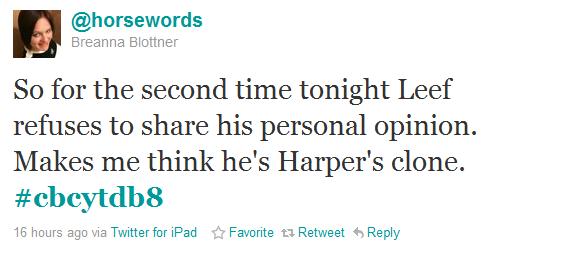
Some of the obvious things that appeared were the standard issues. Some of the candidates are very unfamiliar with the difference between Federal and Provincial/Territorial responsibilities. This was apparent in the answers on free entry staking mining and when discussing education as part of their answers. Much of the time, candidates read their responses from party platforms and their answers seemed flat and uninteresting. In one case, Ryan Leef, the Conservative candidate, refused to answer a question on how the candidates felt about removing support for abortion counseling. His response, that he knew little about the subject so it would be improper to answer, drew a bit of ire from the crowd.

Tweet image

Not all of the questions proposed were asked due to the two-hour time limit on the event. However, a point of note was that some issues, such as health care and the long gun registry, were not brought up in the discussion.

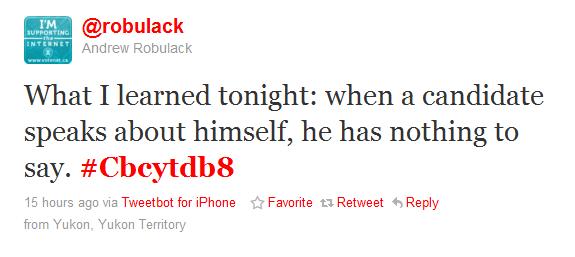
One aspect of many of the responses was the amount of time candidates spent referring to their history. One tweet from the Twitter feed dealt with this: “when a candidate speaks about himself, he has nothing to say.”

Tweet imageWinners? Losers? Most of the comments on Twitter and Facebook suggest that John Streicker, the Green Candidate, was the most passionate and informed. But, in the long run, I don’t see where these forums actually accomplished a great deal.  There should be a more structured debate format rather than the current one next time. The current format does nothing to allow you to differentiate between the various parties and probably adds little to deciding on whom you’d choose.

For all intents and purposes, there should be little more to the campaign. The leaders are all running around safe ridings to ride out the last few days and avoid doing a “Kim Campbell” at the end of the campaign. Few big issues will come forward to prevent making any mistakes in the final days. Now, the main thing that remains is wondering what will come from the NDP polling results, a trend you probably will not see extended to our riding…

Candidates Debate Live Blog

I’ll be covering the Yukon Candidates Debate Live. The debate starts at 7 pm, Wednesday and runs until 9 pm. The link for this is here.

Please note that this will open the live blog in a separate window so you must, at least temporarily, allow popups from the site.

Yup. We’re Yukoners.

Note: This is also my next posting for the CBC Your Take blog.

I attended the all candidates forum on arts issues held in Whitehorse Tuesday evening and have noticed a trend. The candidates don’t want to disagree with each other.

Art forum
Audience and candidates at the All Candidates Arts Forum, Whitehorse, April 19, 2011.

I’m not the only one see this, either. I’ve had comments from people attending the forums that there’s been “a great deal of commonality” on the issues. The local papers have also noted the lack of debate at the forums as well. There have been minor discrepencies between the parties, but, to the greatest degree, the forums have been cordial, respectful and each party seems to put forward the same message: “Yes, we support … (insert issue here).”

Candidates
Candidates at the Arts Forum. L-R: Ryan Leef (Conservative), John Striecker (Green), Larry Bagnell (Liberal), Kevin Barr (NDP)

It took me until this morning to understand what’s going on here. There seems to be some agreement between the candidates to not be antagonistic, aggressive or belligerent. In short, they have been conducting themselves much along the lines as we have been asking them to conduct themselves for years. They’ve given us what we’ve requested.

Here’s the problem. If they’re bickering, we call parliament a daycare. If they’re agreeable, it’s boring. We’re from the Yukon. We spend more than half of the year going, “It’s too cold” and the rest saying, “It’s too hot” in a pretty whiney voice. Most of us list Eeyore as our mentor. 

As a Yukoner, I guess I should express this using a beer analogy. Not having beer is a bad thing but a case would probably be too much. I guess the official election request is “Give us a six-pack.” And, as a working philosophy goes, the six-pack thing pretty much works for me…

All Candidates Forum Illustrates a Big Problem

 Note: This is my latest submission for the CBC Your Take blog.

Put yourself in the shoes of the campaign manager of a major political party in a federal election. What are the three main topics that interest the Student Union of your local college? What three topics are the ones that most resonate with postsecondary students? This afternoon told me that there is a good chance your first guesses would be very wrong.

Yukon College Student Association hosted the first All Candidates forum in the riding today. The format was three main questions, followed by questions from the floor. The three topics that most interested the Student Council and formed the framework of the questions, in order, were:

  • The environment,
  • The monopoly owner of internet, telephone and cellular service, and,
  • Electoral reform
The candidates: John Streicker (Green), Larry Bagnell (Liberal), Kevin Barr (NDP) and, via videoconference, Ryan Leef (Conservative).

Some of the questions from the floor that emerged were those things we would expect from students, such as the proposed RESP credit that makes up part of the Liberal party platform. Homelessness and housing were other expected topics, and given our housing situation in Whitehorse, this was not suprising. However, the wait time for orthopedic surgery was another concern from the floor, as was declining staffing in environmental monitoring offices in the north.

There were some differences in the answers from the candidates, although the extent to which their answers applied to the questions may have not been as much as possible. Most of the times, the candidates did agree, in principle, with the other candidates.

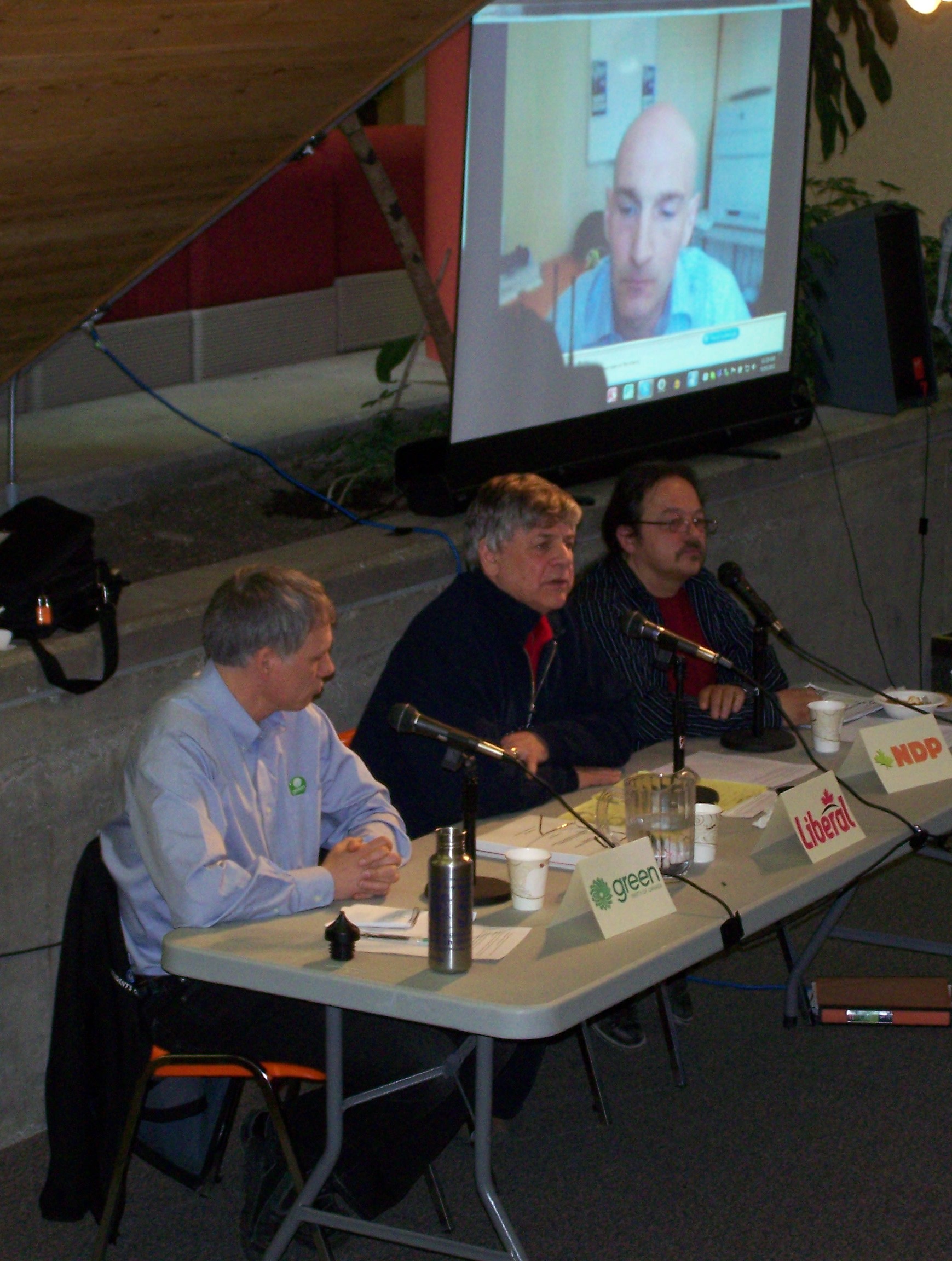
Some different things showed up. There was a difference from usual candidate events because, due to scheduling problems, the Conservative candidate appeared via internet videoconference. This worked quite well, by the way.

But, the biggest thing that came from today’s forum was an incredibly important point. Comparing the interests of the students with the campaign advertising for each of the parties shows a huge discrepancy. These same parties, as a rule, decry the low levels of youth engagement in voting. Therefore, it seems to me that there should have been a huge lesson learned at the College today. Hopefully, the major political parties are “academically inclined” enough to learn it…

An Interesting Development

Note: This is my fourth submission  to the CBC Your Take election blog.

It’s time to wonder what vetting goes into a political candidate for election. There is the understanding, or at least the given, that politicians are human and have pasts. Some of those pasts, however, are not what one would expect… particularly in light of the philosophy of the party for which they are running.

The Toronto Star is reporting that Conservative Party of Canada candidate for the Yukon was convicted in 2009 of falsifying a wildllife report while working as a big game outfitter. Further, he was, at the same time, a wildlife conservation officer who was charged with violating the laws he was supposed to uphold. (I’m also a little curious as to whether or not you’re supposed to be an officer and someone that officer is supposed to oversee but I have to check with Wildlife to see if this is common).

I have no issues with someone paying for an indiscretion. After all, none of us are perfect. However, I have a question for the party. Was the party aware of Ryan Leef’s record before he was nominated? If so, how do you reconcile the party’s tough on crime stance with nominating someone with a conviction and not making that point very clear at the outset of the campaign. Yes, Yukoners have tolerated a variety of politicians with criminal records,  but not as a complete suprise…

End of Week 2

Note: This is the second submission to the CBC Your Take blog. Since I need a summary of who’s running and how things went last time, I did repeat the results from an earlier blog post.

We’ve reached the end of the second week of the campaign. Here’s how things sit. We have four candidates in the Yukon and with the deadline for nominations coming, there seems to be little chance of an independent or one of the smaller parties running this time around.

  • Larry Bagnell (LPC) – Incumbent
  • Ryan Leef (CPC)
  • Kevin Barr (NDP)
  • John Streicker (GPC)

In case you are curious, or your memory needs refreshing, the results of the last election were:

  • Larry Bagnell (LPC) – 45.80%
  • Darrel Pasloski (CPC) – 32.66%
  • John Streicker (GPC) – 12.83%
  • Ken Bolton (NDP) – 8.70%

(Source: Elections Canada – http://www.elections.ca/scripts/OVR2008/default.html)

The second week of campaign is usually a little unentertaining. Since last Sunday, we have seen the release of the major parties campaign platforms. These offer a variety of programs and program spending, complete with the estimates of what they will, or will not cost. Estimate is often a big word, although the Green Party did submit their spending estimates to the Parliamentary Budget office to ensure the numbers do make sense. However, no one around the cafeteria at work has had much to say for or against any of the major parties’ platforms.

In many ways, the election seems to be a quiet surprise. There hasn’t been a great deal of hard core campaigning here and all of the campaigns seem to be very low key. This will probably change with the first of the candidate forums and progress through the (at least)  three more to come. The generally held thought is that it will be either a Liberal or Green Party win this time.

The candidates have done some work today. It’s a sunny Saturday so getting out and around seems a good idea. Two, Larry Bagnell and John Streicker, attended the 18th Annual Bridge Building Competition, where students build bridges using coffee stir sticks, dental floss and carpenter’s glue and these are tested to see how much weight they will support before failing. Ryan Leef was seen with a large group of supporters waving to traffic crossing the bridge into Riverdale subdivision. Larry Bagnell was also doing a walkabout in the Porter Creek neighbourhood today, as well.

The leaders’ debates come up next week. These and the candidate forums do often get people fired up. However, the main things we hear in the Yukon about the leaders’ debates are regarding the barring of Green Party Leader, Elizabeth May. It seems that, regardless of party affiliation here, most people seem to think it was a poor choice. It’s nice to know that most of us can actually agree on something…