
The offshore conundrum

The uproar over the Royal Bank of Canada’s outsourcing IT jobs last week brings to mind the tremendous problem that appears in the industry. The bank, as well as the many other companies that outsource IT jobs to countries which historically lower average wages, claims that the practice allows them to be more competitive.

This has raised the complaint that Canadian IT workers, who earned an average of just over $68,000 annually (Statistics Canada, 2011 figures), should be more competitive. And, here is where the problem lies.

Look at the requirements for your standard worker in the Information and Communications Technologies industry sector. I have a favourite first assignment in two of my courses, where students check the job market to determine what employers are looking for. Some trends are quite evident.

Employers are looking for workers with a minimum of a two-year IT diploma, or a bachelor’s degree in Computing and Information Systems. Frequently, positions require additional industry certifications pertinent to their specific job requirements. Most jobs above the introductory level have minimum experience requirements as well, and the last time my classes went through this exercise in January, these jobs were calling for a three to five- year period of experience for a mid-level job.

Consider these requirements. These workers have invested a minimum of two years in school getting an IT diploma or four for a bachelor’s degree. On top of the costs and time, industry certifications involve experience and the examinations are often costly. For example, the Microsoft Certified System Engineer exams, of which there are 7, cost about $185 Cdn each. Further, these are usually applied exams, where the people taking them are expected to be able to answer questions based upon real life situations rather than simply regurgitate information and people are recommended not to attempt the exams until after at least a year of experience with the product.

On top of this, the average IT program prerequisites call for higher math and problem-solving skills and strong communications skills. The field calls for an above average student to meet the heavy requirements of a position with a high level of technological knowledge and the ability to meet the very flexible requirements of the position. In short, this is usually a field for the “best and the brightest,” who have very good academic skills and has invested a great deal of time and money to obtain a mid- to higher level position.

So, here’s the conundrum. We expect substantial requirements for workers in the field, yet are unwilling to pay them an appropriate salary. We have certainly seen the effects, with all of the major banks in Canada outsourcing many of their IT positions in recent years. Given this trend, we can only assume the trend will continue, with the loss of both jobs and capital from the country…


For sale: one vote

We have an election coming up, namely, the municipal election for the city of Whitehorse. Voting day is October 18th. Elected will be a mayor and six councilors. There is no incumbent running for the mayor’s position and four incumbents running for council seats.

This means I have less than two weeks to figure out who gets my vote (actually, multiple votes as you check off one vote for mayor and up to six for council. There are 5 mayoralty candidates and 22 running for council). In the 21 years I’ve lived here, I’ve voted for a possible mayor every time but have yet to actually cast six  council votes in any election.

Checking out the list of candidates this time around, I don’t see much hopes of finding six to vote for again. It was only shortly before the deadline for nominations that I could see a choice for mayor that didn’t include “none of the above.”

So here are some hints for those who want to get voted in. Note that this probably applies for all elections. A political campaign is a job interview of sorts and the electorate’s only way to choose the right person for the job is the platform put forward by the candidate. So, when expressing your platform:

1. If you intend to deal with an issue, explain how you intend to fix it in detail. Everyone loves kittens, rainbows and unicorns, but general campaign promises without details are usually best moved to the field with a backhoe to make next year’s crop grow that much better. If you cannot provide details, it means you know nothing about the subject other than what to call it.  Honestly, we have enough elected representatives who know nothing. We don’t need more.

2. Prove you have an understanding of jurisdictional responsibility. Each level of government has its responsibilities. If you’re running for one, don’t make promises about things that come under another level of government. This only indicates that you have no clue about the position you aspire to, and probably indicates your level of qualification for it.

3. If you promise something, be prepared to vote that way when the time comes. There is no excuse for supporting something you said you would not support or vice versa. The common story is “after studying the issue,…” or words to that effect. If it was a promise made in your campaign, it meant that you already studied the issue, or should have. Changing your mind in this manner means you either knew nothing about your stand on the issue, or you simply meant to lie your way into office. Unfortunately, we have too many of those cases, too.

4. Have some idea of how financing works. While governments and businesses run through two completely different models and experience in one has no relevance to the other, the general rules of finance are still the same. You can only spend what comes in. Whether through transfers, taxation or borrowing, this income is the maximum you have to provide vital services. And, unlike a business, you simply can’t close the plant and move to somewhere offering lower operating costs. Explain (in detail, again), how you intend to meet your promises and still afford to provide those services.

5. Be honest. Admit it when you don’t know something. Take responsibility for those times when your ideas don’t work. Sometimes you’re going to have to make unpopular decisions (some of the decisions the current council have been decried for are some I heartily approved of). People aren’t going to be happy with everything you do, but will be far more willing to accept it, grudgingly, if you can show you honestly and sincerely feel this is the best choice. The only way to do this is have a long history of being honest and sincere and it doesn’t take much to indicate that these are characteristics you don’t have.

So, there’s my pitch. These aren’t that much in the way of demands for buying my vote. I know it seems a lot, but you’ll probably find that the same price will purchase far more votes than mine…

Truth in Politics

Two news items from this week have prompted my blog post today. These are promos for the season opener for CBC’s Marketplace and the letter written this week by three Conservative MPs to the London Free Press stating that “centrepiece” of NDP economic policy is the implementation of a carbon tax.

The Marketplace opener concerns the labeling of so-called “Green products.” It looks at some of the worst examples of misleading labeling on products. The letter to the London Free Press suggests the NDP, on election would implement a carbon tax, despite the point that a carbon tax has never been proposed by the NDP. In truth, they consistently have supported a cap-and-trade system, similar to that which was an important point in the Conservative Party’s election platform in the 2006 and 2008 federal elections.

Why are these two items related? The first concerns the fact that many terms used in labeling in Canada are not regulated. This makes some sense when one asks questions such as, “What does eco-friendly or green really mean? Given that there isn’t an empirical definition of both, expecting regulation to cover such labeling is unrealistic (on a side note, I am a little surprised to discover that the labeling term “non-toxic” isn’t regulated, either.) This means that there is no requirement to prove claims on labeling that uses these terms. In short, the terms, given their open nature, can be blatant lies. Maybe, it is past the time where some definition of these terms be determined and regulations that protect Canadians from the use of such misleading terms be enforced.

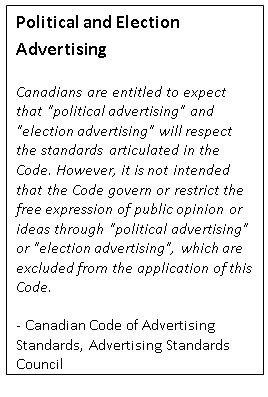
Pull quoteThe tie-in is that we expect political parties and their advertising to be truthful. After all, most people are aware that laws exist to protect us from false or misleading advertising. Therefore, many of us expect that claims made in political campaigns and advertising can be substantiated.

The body in Canada responsible for ensuring our protection from misleading or false advertising is the Advertising Standards Council. Their code outlines what can and cannot be claimed in advertisements. However, what many people do not know is that the code specifically exempts political and campaign advertising from the rules against misleading and false advertising.

Like expressions such as “green,” “earth-friendly,” and “non-toxic” on product labels, claims by political parties and politicians should also be held to a standard where we can expect such claims to be able to be substantiated. When the rules specifically permit falsehoods to be put forward as gospel truth, the rules should be rewritten to ensure our protection as citizens. After all, choosing a government every four or so years is one of our most important tasks as citizens. Doing so with some confidence that claims about other political parties can be verified should be considered a right, and may drag some campaign advertising out of the sewer where much of it seems to reside…

Why Porter Creek D?

Once again, the question of developing the Porter Creek D subdivision has emerged, with the City of Whitehorse, who allocated more than $400,000 for the pre-design of the subdivision in December, despite the objections of a sizeable number of citizens. This week, the city announced that a facilitator will be brought in as part of the planning process.

What emerges from this entire issue is that, while a wide range of groups and individuals are opposed to this development, its only main proponents are the city itself, the Yukon Real Estate Association, and the Whitehorse Chamber of Commerce. In view of this somewhat lopsided number opposing the project, one must ask the question “Why Porter Creek D?”

One of the common proposals put forward in support of this project is the lack of housing in the Whitehorse area. However, this will neither alleviate the immediate needs for housing or the substantially more pressing need for attainable housing. There is nothing in the project that calls for anything other than the status quo in lot pricing, particularly in light of the Yukon Territorial Government policy of pricing lots based on market prices, rather than the actual costs of development. This policy puts the government in a position of arguing that to change would potentially reduce the value of existing lots. At the same time, there has been a wholesale failure to publicly discuss the profits earned on their sale at a higher price. Further, the process of planning, infrastructure development, and sale takes considerable time. An example can be seen in the development of Whistle Bend Subdivision, whose main planning meetings took place in 2006 and will sell its first lots some time this fall.

A point to consider is the population of Whitehorse. When I arrived in Whitehorse in 1991, the population was just under 18,000. In March, the population was estimated to be just over 27,000 (however, just over 2,000 of those actually live outside the city limits). In short, the population has risen by about 7,000 people in the past 21 years. There were also periods where the population fell during this time, as well. Our economy has been “boom or bust” since the founding of the territory and populations have risen and fallen with periods of economy activity and recession.

Yes, we are currently in a boom. However, there is no guarantee this will continue and a view to the economy of Europe facing disaster in the near future indicates that the boom may end abruptly. Will the population of the city hold its numbers? That is something that we must wait and see.

The second aspect of population growth that should be considered is the scope of the Whistle Bend subdivision being brought online this fall. The intention is that the subdivision will house some 8,000 people. This would be an increase in housing that would allow for matching and exceeding the city’s population growth over the past 20 years. In short, given the idea of 20 year growth, the new subdivision well into the development process should provide adequate housing for our needs.

We must also consider the fact that the Whitehorse housing market is also softening a bit, a trend matching those observed nationally, but whether this is an ongoing trend or short term remains to be seen.

It costs a great deal of money to plan and build a subdivision. Why are we spending this when the need does not match historical growth? If sales fall flat, and the population does not increase any faster than it has, there will be quite a few lots available without a market to support it. These will need expensive water, sewer, road and other services regardless whether the new subdivision is actually required. And, even if the population does not increase, infrastructure maintenance costs will.

I don’t mind a bit of pre-planning. In fact, I strongly support being prepared. However, it seems to me that the city, once again, is throwing money away on something that is flash rather than substance, and rather than determining whether or not it is a reasonable requirement. Remember that when you vote for a new mayor and council this October, since several of the candidates for both offices have been strong supporters of this development.

An important anniversary

This last week has been one of important anniversaries. First, on April 9, it was the 95th anniversary of the Battle of Vimy Ridge. Then, on April 15, it was the 100th anniversary of the sinking of the Titanic. And finally, tomorrow is the 30th anniversary of the repatriation of the constitution.

The Constitution Act (1982) represents a major milestone for Canada. Its greatest contribution was the incorporation of the Charter of Rights and Freedoms into the constitution. While the Canadian Bill of Rights was passed in 1960 and did offer protection of some rights, it was also strictly passed as an act of parliament and left parliament with the ability to rescind any of its contents at it leisure. By placing the Charter in the Constitution, it restricts the ability of parliament to change its contents unless through the amending formula, also contained in the Act.

Some parts of the Constitution and Charter have raised questions. The first is the point that Quebec was not a signatory of the constitution in 1982 and two attempts to integrate the province into the fold have failed. However, this is probably not as great an issue as some have made of it, in that the province has used section 33(1), the “notwithstanding” clause on several occasions and it can be argued that by using part of the constitution in court of law, they have informally adopted it.

One of the main sections of the Charter is section 15 (1), which states that: “Every individual is equal before the and under the law and has the right to the equal protection and equal benefit of the law without discrimination and, in particular, without discrimination based on race, national or ethnic origin, colour, religion, sex, age, or mental or physical disability.”

This is also one of the most contentious parts as well, since it has been used for a number of Supreme Court of Canada cases whose outcome has sparked controversy. It has led many to condemn the clause since it can be seen as setting the Supreme Court in a position to “make laws,” a role relegated to parliament. This is a bit of a specious argument since acts passed that have not withstood a Charter Challenge usually did so because the acts in question should have been better drafted, rather than the Supreme Court directly intervening in the making of law.

Have there been decisions that you didn’t like? I think all of us could find a decision that makes us scratch our heads and wonder what someone was thinking. We could probably all find one or two that we definitely disagree with. However, these illustrate a very significant concept.

While you might not agree with some of these, you should consider them in the framework of what these indicate. We have a constitution that states that everyone is equal before the law. And, not only does it say that everyone is equal, but we actually enforce that principle. While you may not agree with how it has worked out sometimes, this is a thing of which we can all be damned proud…

Rent is… how much??

Our ongoing issues with the neighbour across the street finally came to an end last fall when he moved from Whitehorse to Carmacks. Collectively, most of us on the street breathed a collective sigh of relief when he left.

Then, in January, we got a new neighbour. Shortly after he moved in, I met him while we were both cleaning out the driveways. We had a chat for about half an hour. He moved to Whitehorse in the beginning of January when he transferred here for work. His family was coming shortly and he needed a place on relatively short notice. When I came back into the house, Clara asked, “What is he like?” The only response I could come up was that thing we came up with when we were young and brought home a stray animal: “I’m keeping him!”

Sadly, I’m not keeping him. He came over yesterday to tell us he was moving out that day. He found another place, renting a basement in Riverdale. Although he said he really liked the neighbourhood and the people on the street, the place he was renting was inadequate and far too expensive. He figured that the new place in the winter would cost about $1,000 per month less by the time he added the cost of heating and lights. While the place would be smaller, the cost of the trailer across the street was far too high.

What was he renting? First, the trailer was quite run-down and the wear and tear of having two junk dealers and a crack house was pretty extensive. For example, the owner remarked a few years ago that she cleaned more than 1,000 needles from the house after the crack dealers left and they had the disturbing habit of not walking as far as the washroom when there was a perfectly good floor to use for that purpose. The place is poorly insulated, as most 40-year-old trailers are. However, the house does have a large shop attached to the trailer and a heated basement. These might offer some additional benefits; however, they are not part of the rental and cannot be used. Further, the smell of dog or cat urine in parts of the house is not conducive to either happiness or health. For these stunning accommodations, the rent is $1,400 plus heat and lights a month. Oh, by the way, part of your heating costs go to heating the basement you’re not allowed to use.

How, you ask, can you get away with such an exorbitant rent for such conditions? The answer is seen in the vacancy rate, which was 1.3% in Whitehorse in March of this year (note that houses being rented are not included in the vacancy rate calculations). There is so little housing available that costs are quite high for some rather poor levels of accommodations. The average rent for a 3+ bedroom apartment in a small apartment building is $1,475 per month, although the vacancy rate in March for such accommodations was 0%. In short, regardless of how trashy your rental unit is, you will not only find someone who will rent it but you can also charge a king’s ransom for it.

Something has to be done with the shortage of housing in Whitehorse. Until the territorial government and the city get their acts together, and both have a long way to go in achieving that status, the cost of housing will remain high, even for slums…

The cost of education

I have been watching the student protests in Quebec over rising tuition costs with some interest. First, I do teach at the postsecondary level so I do have a vested bias in education as a general concept. Throw in the fact that after primary and secondary school and a couple of university degrees, with the longstanding joys of student loans, I do have a decent idea of the significance of paying for an education. I also sit in the third seat involved, namely, that a portion of my taxes paid to the territorial and federal governments go towards providing education services.

All of my experience has led me to wonder about the terminology used in the discussion of this issue and whether or not this has resulted in all three groups considering the issue of the economics of education in the wrong light. Students, of course, complain about the high cost of education. That being said, Quebec has a traditionally low fee structure for university students and the average annual university tuition in Quebec is about $800 year less than that of Yukon College. On average, students leave university with a degree and a substantial debt load. Governments also face increasingly high budget forecasts, with the costs of education transfers, staffing, building maintenance, curriculum revision, etc. And, tax payers constantly call for lower taxes, wanting to reduce the pool of funds available for all government services, not just education alone.

All three groups have missed the main point here. The main consideration is that education costs nothing. Nope. Not a penny. Education is not a cost. It is an investment and students, governments and taxpayers should all keep that in mind when the aspect of educational economics rears its head. Like investments, the monies paid toward education at all levels will often pay off, just not in the “now.” Investing is done for the future and if the any of the parties involved are only interested in what yields results in the present, they deserve a certain degree of disappointment and shouldn’t really be surprised when their contrary opinions are simply, and justifiably, ignored.

Think of the alternatives to education spending. For one thing, an educated workforce means a larger workforce. This, in turn, reduces the requirements for spending on transfers for social assistance, Employment Insurance and low income tax credits. And, people with larger incomes tend to spend more, reintroducing monies back into the economy. As a double bonus, those with higher incomes contribute more to taxation revenues for governments at all levels. There are additional benefits. Consider the arguments used by provinces, territories and municipalities to lure new industry to their region. The big point of any such discussion is infrastructure. Unfortunately, most tend to think of infrastructure in terms of roads, power and facilities for employees. Industry, however, also considers a more valuable aspect of infrastructure, namely, a trained workforce. Finding employees that are capable of fulfilling your needs is difficult, particularly when your requirements involve a staff with a high level of technical training. No one wants to train an employee from scratch and no one wants to try to fill an entire facility with employees gleaned from elsewhere, where the costs of staffing your facility will include incentives to relocate and, often, relocation expenses, as well.

Like any good investment, contributions are required from a variety of levels to make these viable. And, like any good investment, the dividends are delivered over an extended period of time. So maybe, if we thought of education as the investment in personal growth and citizenship contribution it actually represents, all levels would reconsider their rhetoric and just place the emphasis on the topic that it deserves…

An open letter to the Conflict of Interest and Ethics Commissioner

Ms. Mary Dawson

Office of the Conflict of Interest and Ethics Commissioner
Parliament of Canada
Centre Block, P.O. Box 16
Ottawa, Ontario
K1A 0A6

By E-Mail

Dear Ms. Dawson:

I note that, this evening, the House of Commons passed legislation to order two unions of Air Canada employees to binding arbitration to prevent strike action. This action could be seen as being highly beneficial to both the corporation and its shareholders. This raises my question as to the potential motivation and the potential of conflict of interest in some of the members voting in favour of this legislation.

I know that there is a requirement for member disclosure on election on their personal holdings and wish to know how many of the members who voted in this matter have  personal portfolios that  include share holdings in Air Canada or its subsidiaries.  I also respectfully request that appropriate action be taken under section 8 of the Conflict of Interest Code for Members of the House of Commons.

Yours truly,

Doug Rutherford
Whitehorse, Yukon, Canada


Hewers of wood?

One of the more common ideas presented about the Canadian economy is that we have a resource-based economy and are liable to fluctuations in resource demand. This is seen, for example, in the recent comments by the Natural Resources Minister regarding the need to ensure that oil/gas and mining development projects should have their approval processes streamlined to ensure that these important components of our economy are developed more quickly.

Unfortunately, this is a misconception. Consider the GDP figures from 2001-2010 for industry sectors in Canada. The two sectors relating to resource production are:

  • Agriculture, forestry, fishing and hunting
  • Oil and gas and mining extraction

In 2002 dollars (reported in this way for comparative purposes over the 10-year period and I’m rounding to the nearest billion dollars), the contribution to GDP for agriculture, forestry, fishing and hunting was $26B in 2010, while that of oil and gas and mining extraction was $54B, for a combined resource-based contribution of $80B.

Now, please do not imply that I’m degrading $80B. If nothing else, it’s far better than a poke in the eye with a sharp stick. However, comparison with other industry sectors, this is a relatively small amount. For example, manufacturing alone contributed $160B to the GDP in 2010, twice the value of all resource-based industry sectors. The construction industry contributed $74B to the economy in 2010, almost the value of all resource-based industries combined. Of the GDP for just goods producing industries alone, natural resources account for only about 23%.

Where our economy receives its largest contributions come from the service sector. For example, educational services, at $62B is larger than either resource component, as is wholesale ($70B) and retail ($76B) trade, transportation and warehousing ($58B), professional, scientific and technical services ($61B), etc. In fact, the largest industry sector contribution to GDP comes from the financial industry, which has a total contribution of $257B, or more than three times the combined natural resources industries in 2010.

Keep in mind that the service sector does service something. It is safe to assume that, without the goods producing industries, we would not have a large a service industry as well. On the other hand, since industries other than natural resources represent 77% of the goods-producing economy, it is obvious that not all service sector components are dependent on resource production, either.

Are we a resource-based economy? Since natural resources contribute slightly more than 6% of the total Canadian economy, this is a claim that is no longer valid and has not been for some time. In 2001, natural resources represented 7% of the economy, so the actual contribution of resources to the Canadian economy actually declined. This is true in spite of the economic downturn in 2008 which tends to penalize industries related to the production of finished goods more than raw material generating industries.

Perhaps it’s time that the federal government consider its policy development around the largest components of our economy, rather than fixating on one smaller aspect. Policies that support manufacturing industries or encourage the financial industry would have a substantially greater benefit to the economy than making it easier to fast-track mining and oil and gas development projects. Unfortunately, dealing with facts is something our present government seems reticent to do…

Excuse me?

Two weeks ago, I had a somewhat bizarre incident where a city truck jumped the line waiting at the car wash. I complained to the city and it was passed on to the City Manager. I finally got a response the other day and I’ve been shaking my head ever since. It contained the following:

“We have dealt with the  issue and now consider it closed.”

Wait a second. Doesn’t  the person who complained determine if a matter is dealt with acceptably? It seems to me that I finally understand why a city employee can conduct himself in an arrogant and superior manner. After all, if the city manager is above the mere mortals who pay his salary, why can’t the remainder of the staff be that way…