What Would Happen If There Were No More Hypothetical Questions?

This is my next submission to the CBC Your Take election blog.

Breaking News from the CBC Your Fake blog.

Godzilla has emerged from the Yukon River and eaten all four candidates for the Yukon riding. Elections Canada tells Yukoners to vote anyway and a candidate will be appointed by the winning party after the election.

I’m assuming, by now, that you’ve figured out that this is a hypothetical situation. But, what would you do in this case? How do you deal with removing completely personalities from the election?

Let’s start by asking the following questions.

  • Do you know who you would vote for?
  • Would you vote the same way as you would if the original candidates were still in the running?
  • Would you still vote?
  • What criteria would be the defining ones for making your choice?

A recent Nanos poll has put the key reason for deciding on a specific candidate as being party policy, as opposed to the leader, the local candidate and voting for a traditional party, in that order. I’m not sure I trust the accuracy of a sample of 1200 people who haven’t gotten around to ditching their land line. I’m even less sure that it has a chance of representing a fair picture of Canadian opinion. However, granting a little bit to the possible accuracy of the poll, I find the idea that the actual candidate places third in the list of reasons for voting specifically alarming.

Remember who it is you elect on May 2nd. You elect your local representative and that is all. This is the person who represents you to the government of Canada and, as such, picking that person is an extremely important decision. In Canada, we don’t elect a government, a party or a Prime Minister. Those things get dealt with after the election and are subject to change without notice in a variety of legal and legitimate possibilities.

So put a little thought into how you would choose your next Member of Parliament. Ignore the partisan rhetoric and hyperbole and ask yourself who you would most want to represent you. Take the time and effort (as ridiculously little as it takes) to make your choice for that person at the polls.

And, don’t worry. I don’t think the river is deep enough to hide Godzilla…

A Few Simple Rules for Candidate Forums

Revised

As of Friday evening, half of the all candidate forums for theYukon election are over. At that point, Bringing Youth Toward Equality (BYTE) sponsored a forum on youth-related issues and raising the profile of politics for those least likely to vote.

Having attended both of these forums, I can’t help but notice a few points that candidates should consider in the last half of the campaign.

Statistics

Statistical arguments do have a place in this world, but these deal with making reference to specific data. When you do this, you should be doing it with definite figures from your notes that relate exactly to the situation at hand. Sadly, 74.2% of all statistics are made up on the spot. For example, one candidate stated in the last forum that less than 60% of eligible Yukoners voted in the last election. That is actually the national figure. About 64% of eligible voters in the territory did make it to the polls. Also, another candidate suggested that theUS deficit now stood at $1 trillion. It’s actually expected to be $1.5 trillion. When you get to talking about trillions of dollars, 0.5 does have some meaning.

Repetition

If you really know your party platform, you will have something to actually say when answering questions. If you’re really sure of the party message, you will be able to explain these concepts without buzz words or obviously politicizing your responses. Stating that the only way to be sure that something will happen is to vote you in as a candidate and giving your party a majority government was not the proper answer for any of the questions asked in either Thursday’s or Friday’s forum. Answer the question directly and you may find the voters will respond.

Your Train of Thought

An all candidates forum is like a job interview. The job you are interviewing for is one requiring excellent public speaking skills and the ability to present a cogent argument. Being well prepared and knowing what specifics your party has in mind to deal with issues should keep your train of thought from derailing.

Plants

Everyone knows that the parties plant questioners at these events. If your communications director doesn’t do this, you may need a new one. Despite this, polite conduct does suggest that plants are supposed to make an effort to be subtle. When a) someone shows up for the youth forum wearing a suit, b) starts the question with a partisan shot at the incumbent and, c) asks a candidate, by his first name, to list why his policy is so superior, the rules of subtlety have fallen away.

When more than 74.2% of the audience roll their eyes at the question, a few more acting lessons should have been called for…

All Candidates Forum Illustrates a Big Problem

 Note: This is my latest submission for the CBC Your Take blog.

Put yourself in the shoes of the campaign manager of a major political party in a federal election. What are the three main topics that interest the Student Union of your local college? What three topics are the ones that most resonate with postsecondary students? This afternoon told me that there is a good chance your first guesses would be very wrong.

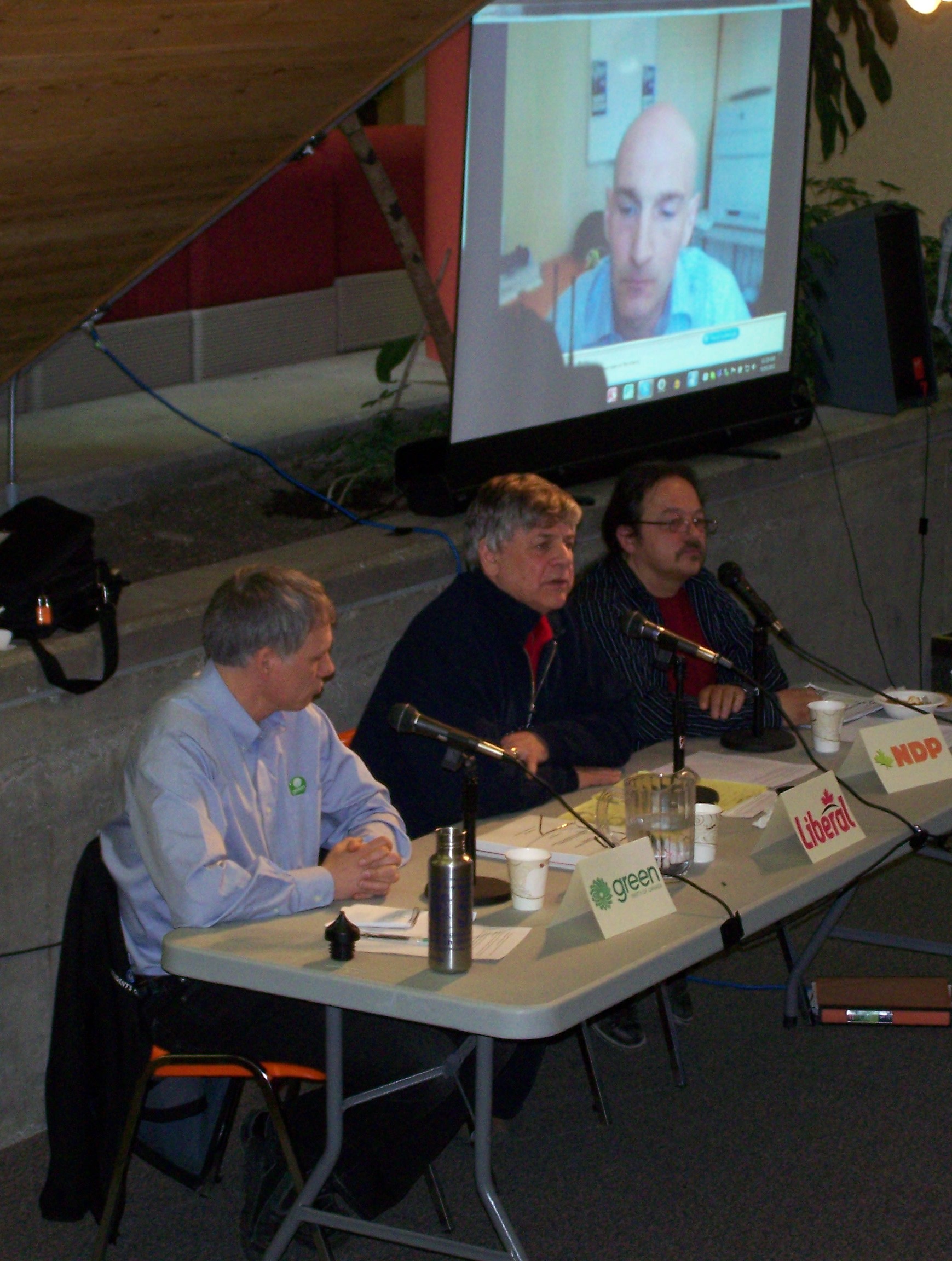
Yukon College Student Association hosted the first All Candidates forum in the riding today. The format was three main questions, followed by questions from the floor. The three topics that most interested the Student Council and formed the framework of the questions, in order, were:

  • The environment,
  • The monopoly owner of internet, telephone and cellular service, and,
  • Electoral reform
The candidates: John Streicker (Green), Larry Bagnell (Liberal), Kevin Barr (NDP) and, via videoconference, Ryan Leef (Conservative).

Some of the questions from the floor that emerged were those things we would expect from students, such as the proposed RESP credit that makes up part of the Liberal party platform. Homelessness and housing were other expected topics, and given our housing situation in Whitehorse, this was not suprising. However, the wait time for orthopedic surgery was another concern from the floor, as was declining staffing in environmental monitoring offices in the north.

There were some differences in the answers from the candidates, although the extent to which their answers applied to the questions may have not been as much as possible. Most of the times, the candidates did agree, in principle, with the other candidates.

Some different things showed up. There was a difference from usual candidate events because, due to scheduling problems, the Conservative candidate appeared via internet videoconference. This worked quite well, by the way.

But, the biggest thing that came from today’s forum was an incredibly important point. Comparing the interests of the students with the campaign advertising for each of the parties shows a huge discrepancy. These same parties, as a rule, decry the low levels of youth engagement in voting. Therefore, it seems to me that there should have been a huge lesson learned at the College today. Hopefully, the major political parties are “academically inclined” enough to learn it…

Maybe Two Hours Meets the Definition of Eternity

Note: This is my latest submission to the CBC Your Take election blog.

I made a great deal of effort, and rescheduled several things on the fly, to watch the English language leaders’ debate last night. The presentation started with an interesting poll statistic, namely, that 64% of the respondents probably wouldn’t change their vote based on the debate. About 25% said they could be swayed.

That being said, I don’t see anyone being swayed by last night’s performance.  I’ve heard the various parties talking about how well their leader did in the debates. That could, however, probably be summed up by the fact that no one lost it, rather than anyone having won it.

One of the rules for the debate is that the leaders could use index cards for notes to use during the presentation. I really only noticed M.  Duceppe obviously doing this, but that probably reflected itself in the fact that he was the only one who did not repeat themselves continuously through the entire show. My suggestion for the next time is the following rule: if you use a party buzz phrase (e.g., jets and prisons, Stephen Harper’s best friend, job-killing taxes, etc.) more than twice in the debates, you should be required to resign as party leader.  Two hours of debate is for putting forward two hours of your viewpoint on the issues rather than the same thing again and again. M. Duceppe does deserve kudos for not doing this as much as the three other leaders but he wasn’t innocent of this either.

Also, the communications people really should take some of their leaders aside and give a few hints on television presentation. First, Mr. Harper should be told not to make every statement directly to the camera. Yes, it does look good to make your points to the audience as well as the other leaders; however, when you do it all the time, it looks a little creepy. No offence, but…

Also, Mr. Ignatieff’s staff should make him spend some time with his hands below the podium. Nervous hand gestures are a habit and hard to break but are a bit distracting (I’ll also concede that he’s allowed to be a bit nervous considering it was his first  televised leaders’ debate).

Living in the north, I was curious to hear what northern issues may be on the leaders’ plates. Sadly, I’m now assuming that the answer to that question is “None.” I was also a little dismayed to find that women’s issues came up, but only in passing and only an hour and a half into the two hour debate. Obviously, no one remembers that women do make up 52% of the population and are rumoured to occasionally vote. And, while all parties claim to be interested in getting youth re-engaged in the election and increase their voting rates, the only youth issues brought forward involved youth and crime.  And… “bling??”

Maybe, I did expect a bit too much. Performing under pressure for two hours cannot be easy. Comparing it to Question Period isn’t fair, either, as QP is only 45 minutes and you are not the only one expected to represent the party. I must also admit that moving the French language debate to this evening was a good plan, though. If last night’s performance was any indication, we could probably guess how well its ratings would fare against a Bruins-Canadiens game…
Today Is Brought To You By The Letters “A” And “G”

This was supposed to be a quiet day in the campaign. After all, most of the leaders are hiding away preparing for the first of the debates. Suddenly, Canadian Press releases a draft of an Auditor General’s audit on the G8/G20 meetings. This draft version (please note that there is more than one of these floating around) states that $50 million were spent on projects in Tony Clement’s riding, quite a distance from the conference and that the government mislead parliament. The report suggested that such methods used to obtain the funds were illegal.

Needless to say, this caused a wee bit of excitement on the campaign and certainly raised the stakes in the coffee break discussions this morning. Basic take on it from everyone I talked to was that, if true, this should result in the complete devastation of the Conservative Party in the polls.

Later in the day, word of a supposedly later draft emerged…. reputedly also from the Auditor General’s office regarding the same audit. This was referred to by John Baird who said that the language referring to misleading parliament had been removed. He also did state that he could not release the complete language of the draft in question.

However, the CBC’s Greg Weston has stated that he has talked with someone who has seen all the drafts and the language has few changes from the first released draft. Apparently, it’s quite damning. That being said, we should all remember that we are talking about drafts whose actual origin hasn’t really been confirmed. This is important because the final report has been written and is the hands of the Prime Minister.

There was call last week from the opposition parties to release the final document. The Prime Minister refused to do so. Here’s the rub. Now, when the conservatives may well want to release this, comes the reminder that they can’t. The AG’s report can only be released to parliament and parliament won’t sit, of course, until after the election. Releasing it beforehand has a name: contempt of parliament. This should lead to a marvelous litany of, “It said this” and, “No, it didn’t” There should be a substantial amount of outrage to go with this.

On top of this, the Auditor General makes the news again this afternoon. On the last day of parliament sitting, The Conservative Party submitting a dissenting report on the G8/G20 meeting funding stating that the AG had supported the expenditures in question. However, it appears that the quote in question related to a March 2004 report on security funding after 9/11. Ms. Fraser sent a scathing request to have the quote removed from the report. The Conservative Party did admit that there was a error and it would be investigated; however, Stockwell Day, who is not running in the next election, was the one representing the party on this.

So, expect the words “Auditor General” to play a big part in tomorrow’s debates. Just a head’s up.

An Interesting Development

Note: This is my fourth submission  to the CBC Your Take election blog.

It’s time to wonder what vetting goes into a political candidate for election. There is the understanding, or at least the given, that politicians are human and have pasts. Some of those pasts, however, are not what one would expect… particularly in light of the philosophy of the party for which they are running.

The Toronto Star is reporting that Conservative Party of Canada candidate for the Yukon was convicted in 2009 of falsifying a wildllife report while working as a big game outfitter. Further, he was, at the same time, a wildlife conservation officer who was charged with violating the laws he was supposed to uphold. (I’m also a little curious as to whether or not you’re supposed to be an officer and someone that officer is supposed to oversee but I have to check with Wildlife to see if this is common).

I have no issues with someone paying for an indiscretion. After all, none of us are perfect. However, I have a question for the party. Was the party aware of Ryan Leef’s record before he was nominated? If so, how do you reconcile the party’s tough on crime stance with nominating someone with a conviction and not making that point very clear at the outset of the campaign. Yes, Yukoners have tolerated a variety of politicians with criminal records,  but not as a complete suprise…

Debate Debacle

Note: this is my third submission to the CBC Your Take election blog.

There was quite a bit of controversy when Elizabeth May, leader of the Green Party of Canada, was not permitted to take part in the leaders’ debates. The reason given by the broadcasters’ consortium that oversees this was that, since there were no sitting Green Party members at the time of dissolution of parliament, she could not take part. This was a repeat of the 2006 election debates, which was finally solved when some of the other leaders pressed for her inclusion.

This time around, some of the leaders said that there was nothing they could do and that the decision lay in the hands of the broadcast consortium. An attempt to have the Federal Court of Canada hear an expedited appeal was turned down by the court so an appeal of this in court would not take place until after the debates had occurred.

But now, there is a far greater threat to the fairness of the debates… one that has brought up by both the Bloc Quebecois and the New Democratic Party. It seems that the French language debates, scheduled for Thursday evening, will occur at the same time as a Montreal-Boston playoff hockey game. There is serious fear that people will be far more interested in the game than in the debate. In a letter to the consortium, Gilles Duceppe asks them to move the debate up to Wednesday, since the programming conflict will be “heartbreaking” for many Quebecers. Jack Layton said he suspected many people would choose to watch the game over the debate and that, “Were I not in this election, I might well make the same decision.”

After all, hockey is pretty dangerous stuff. BC doctors are being reminded that they are not to discuss hockey during operations, for example. That obviously indicates that danger of contrasting hockey with other topics, such as democracy… a battle which many think hockey will win.

What I find particularly interesting is that here are two leaders of parties asking the broadcast consortium to alter their original plans because of a hockey game. That is obviously a far better reason to change their plans than to, say, include a party leader who garnered almost one million votes last election. I guess we all have our priorities…

End of Week 2

Note: This is the second submission to the CBC Your Take blog. Since I need a summary of who’s running and how things went last time, I did repeat the results from an earlier blog post.

We’ve reached the end of the second week of the campaign. Here’s how things sit. We have four candidates in the Yukon and with the deadline for nominations coming, there seems to be little chance of an independent or one of the smaller parties running this time around.

  • Larry Bagnell (LPC) – Incumbent
  • Ryan Leef (CPC)
  • Kevin Barr (NDP)
  • John Streicker (GPC)

In case you are curious, or your memory needs refreshing, the results of the last election were:

  • Larry Bagnell (LPC) – 45.80%
  • Darrel Pasloski (CPC) – 32.66%
  • John Streicker (GPC) – 12.83%
  • Ken Bolton (NDP) – 8.70%

(Source: Elections Canada – http://www.elections.ca/scripts/OVR2008/default.html)

The second week of campaign is usually a little unentertaining. Since last Sunday, we have seen the release of the major parties campaign platforms. These offer a variety of programs and program spending, complete with the estimates of what they will, or will not cost. Estimate is often a big word, although the Green Party did submit their spending estimates to the Parliamentary Budget office to ensure the numbers do make sense. However, no one around the cafeteria at work has had much to say for or against any of the major parties’ platforms.

In many ways, the election seems to be a quiet surprise. There hasn’t been a great deal of hard core campaigning here and all of the campaigns seem to be very low key. This will probably change with the first of the candidate forums and progress through the (at least)  three more to come. The generally held thought is that it will be either a Liberal or Green Party win this time.

The candidates have done some work today. It’s a sunny Saturday so getting out and around seems a good idea. Two, Larry Bagnell and John Streicker, attended the 18th Annual Bridge Building Competition, where students build bridges using coffee stir sticks, dental floss and carpenter’s glue and these are tested to see how much weight they will support before failing. Ryan Leef was seen with a large group of supporters waving to traffic crossing the bridge into Riverdale subdivision. Larry Bagnell was also doing a walkabout in the Porter Creek neighbourhood today, as well.

The leaders’ debates come up next week. These and the candidate forums do often get people fired up. However, the main things we hear in the Yukon about the leaders’ debates are regarding the barring of Green Party Leader, Elizabeth May. It seems that, regardless of party affiliation here, most people seem to think it was a poor choice. It’s nice to know that most of us can actually agree on something…

The Yukon Riding

Note: This is the first of my submissions to CBC’s Your Take blog.

People often have a little trouble grasping the expanse of the Yukon, a single riding located in the northwest corner of Canada. We are 85 times the size of Prince Edward Island, the smallest province, yet have less than one quarter of their population. People of First Nations origin represent about 25% of the population.

The topography of the Yukon is as varied as one can expect. The eight highest mountains in Canada are located in the St. Elias Mountain Range, located within Kluane National Park (a UNESCO World Heritage site). Above the Arctic Circle, tundra abounds, along with the Porcupine Caribou herd, one of the largest in North America. Subarctic boreal forest also covers much of the territory. Large lakes and rivers are common. The Yukon River, with a length of 3,185 km, is the second longest river in Canada. We do things big here.

There are 14 communities in the territory, ranging from Watson Lake at the gateway to the Yukon on the Alaska Highway to Beaver Creek, the most westerly community in the country, to Old Crow in the north. That being said, our total population, from the December 2010 estimate, is just under 35,000. (I realize that there are towns with a smaller population in many parts of Canada. Consider that Whitehorse, the capital city, has an estimated population of 26,000, if you include the surrounding bedroom communities.) Think in these terms: there are two moose and six caribou for every person in the territory. We also have a grizzly bear for every family of five.

A number of prominent Yukoners have served in the House of Commons, including George Black, He served in the House from 1921-1935 and 1940-1949. In the period between , the seat was held by his wife, Martha Louise Black, during a period of illness. He was Speaker of the House following the 1930 election and reputedly kept a .22 caliber pistol in his chambers to hunt rabbits on Parliament Hill. 

In 1957, Erik Neilson was elected as the Yukon MP and served until 1987 when he resigned. He held a variety of cabinet positions, including Deputy Prime Minister, President of the Privy council and Minister of National Defense.

From 1989-1995, the member was Audrey McLaughlin. She was the first female leader of a political party with a seat in the house and the only federal leader to represent a riding in one of the territories.

I also find it interesting that most people from outside the region often don’t know where we are. The usual response that makes the lights come on is “we’re right next to Alaska.” I do explain that Skagway, AK, is about 2½ hours drive away. I try not to tell them that I have to drive south to get there…

Waiting for Local Issues

So far, there seems to be little in local issues really coming to the fore. But, there also seems to be little in the way of real policy being pushed by any of the parties.

There does seem to be a little protest, though. The local conservative candidate hasn’t said much other than the official party talking points. Given the perception that the Conservative Party goes to great lengths to stay on message, it does bring to mind how the two local papers have both printed stories with all of the official words in quotes: coalition, island of stability, etc. It’s actually kind of funny.

We’re still waiting to hear final dates for some of the all candidates forums. The youth issues forum, organized by Bringing Youth Towards Equality (BYTE) is scheduled for the evening of April 15th. All four candidates are reported to be attending.

The Arts Issues forum still has not been scheduled, but apparently can only be on one of two dates. This was very well attended in the 2008 General Election.

CBC Yukon is also organizing the all candidates forum for the evening of April 27th. There has been no word, however, confirming whether or not the Whitehorse and Dawson Chambers of Commerce, who have sponsered similar events in the past, plan to do so this time around.

And that’s it for today. I do get to have those horribly unprolific days and using them up in the 2nd week of the election campaign, a notoriously slow part of an election, seems the be approach.